Some of my favorite recordings are by Ryan Adams. I like some of his CDs more than others, which may not be surprising considering how productive and diverse Adams is. I find some of his songs are fire, and others are ashes. But overall, he is one of the most talented artists now making music. And on October 11, he is releasing a new solo effort, Ashes & Fire. He just released one of the songs, “Lucky Now.”
Reports indicate the CD will have a country-rock sound, featuring guests Norah Jones and Benmont Tench of Tom Petty & the Heartbreakers (piano). From the sound of “Lucky Now” (as well as some clips of live performances of other new songs), the CD looks promising. I can’t wait.
What are your favorite Ryan Adams CDs or songs? Leave a comment.
As Chimesfreedom prepares for Hurricane Irene in New York, we wish others in the hurricane’s path to be safe in weathering the storm. Hopefully, we soon will be wishing Irene goodnight, as in the great song. Unlike the hurricane, “Goodnight Irene” is timeless, so that nobody knows where the song originated. Huddie Ledbetter, i.e., Lead Belly, made the first recording of the song while he was in the Louisiana State Penitentiary. His recording is a beautiful, haunting version of the song about the deep sadness of lost love, as the singer tries to warn others to avoid his fate (“Stay home with your wife and family / And stay by the fireside bright”).
Pete Seeger’s The Weavers helped make the song a national hit in 1950. And there have been numerous covers through the years, including interesting upbeat versions by Fats Domino and by Brian Wilson (the latter is on the tribute CD, Folkways: A Vision Shared (1988)).
In the version below, Pete Seeger sings with the great Mississippi John Hurt, who tells a story about getting his first guitar. Then, the group, which includes folk-singer Hedy West (“500 Miles“) and banjo player Paul Cadwell, breaks into playing “Goodnight Irene.”
The above performance appeared on Rainbow Quest, a show Pete Seeger started on a local UHF New York television station in the 1960s. At the time, many television stations feared featuring Seeger, who had been blacklisted because he asserted his First Amendment rights before the House Un-American Activities Committee. Fortunately, through YouTube, many more people get the opportunity to see some great performances hidden away at the time. Seeger, who now is a respected sage from a different time, has always been a bit of a hurricane himself.
What is your favorite version of “Goodnight Irene”? Leave a comment. In times of natural disasters, it is always a good reminder to help others by donating to organizations like the Red Cross.
On August 26, 1974, Charles Lindbergh died of cancer in Hawaii at the age of 72. Lindbergh was the first person to fly solo nonstop across the Atlantic Ocean, and he is also the subject of one of my favorite bio-pics, The Spirit of St. Louis.
Looking at the year he died, it is difficult for me to believe that Lindbergh’s life overlapped with my childhood, as he seems from another age. And 1974 is not that long ago. Similarly, his talented wife, Anne Morrow Lindbergh lived until 2001.
The Spirit of St. Louis, directed by Billy Wilder, is the movie I saw in my childhood that established Jimmy Stewart as one of my favorite actors. It is a compelling movie about a unique type of heroism, and Jimmy Stewart must carry the movie. If he is not interesting, the movie fails, because a key segment of the movie is Stewart alone in the plane. But the film works and captures the drama, fear, and loneliness of that first solo transatlantic flight.
Lindbergh’s solo 33-1/2-hour trip, where he had not slept for 55 hours, was a kind of isolation that is rare in this modern world with crowded airplanes, cell phones, and Internet access to the world. Like Michael Collins’s trip around the dark side of the moon after separating from Neil Armstrong and Buzz Aldrin in 1969, Lindbergh’s uncertain groundbreaking trip required a special resolve to face one’s fears alone.
And the movie The Spirit of St. Louis does an excellent job of showing that isolation, as well as the logistics and preparation involved.
After the Historic Flight
Although Lindbergh’s life continued past his flight and even past where he saw Apollo 11 land on the moon, the film rightfully ends with Lindbergh’s heroic triumphant flight in 1927. Unfortunately, the rest of Lindbergh’s life would not always be so happy.
In 1932, Lindbergh lost his son in an infamous kidnapping and murder. And as World War II approached, his statements about the war made him a fallen hero. He argued against U.S. involvement in the war, making controversial statements supportive of the Nazis. But after the war broke out, he served in the Pacific as a military observer and flew combat missions.
Each one of those stages are worthy of more discussion — or additional movies, because Lindbergh was a complex man. There is Forward From Here: Leaving Middle Age–and Other Unexpected Adventures, a book by Lindbergh’s daughter Reeve Lindbergh, where she recounts her discovery after her parents’ deaths that her father had three secret families in Europe. Using fiction to consider Lindbergh’s complexities, author Philip Roth wrote a novel, The Plot Against America, that imagines an alternate history with an anti-Semitic Lindbergh being elected president over Franklin Delano Roosevelt.
It is difficult not to ask questions about the choices that Lindbergh made in his life, where he resided on the edge between being a hero and a villain, between joy and tragedy, between order and chaos. We may revisit some of these topics in the future, but for today, on this anniversary of Lindbergh’s death, if you are interested in the heroic flight, the James Stewart movie is a great place to start.
I have been to the spot on Long Island from where Lindbergh began his historic flight. But unfortunately, it is a shopping mall.
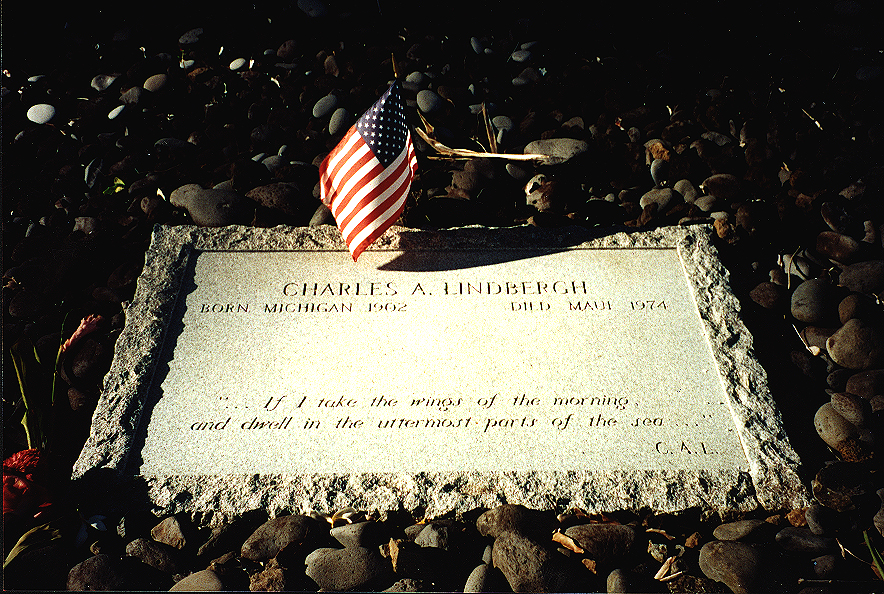
Fortunately, Lindbergh’s body received a better burial. After he died, he was buried on the coast of Hawaii next to the ocean. The inscription on his tombstone includes a phrase from Psalm 139: “If I take the wings of the morning, and dwell in the uttermost parts of the sea.” Although the Psalm continues, the inscription on Lindbergh’s tombstone ends there, leaving the reader mid-sentence, wondering if you do that, then what? Just like Lindbergh’s life, the inscription leaves one with many questions.
Have you seen The Spirit of St. Louis? What did you think of it? Leave a comment.
On August 31, 2011, the B.B. King Blues Club in New York is hosting “Spirit of Mink DeVille”: The 2nd Annual Willy DeVille Memorial Concert. Willy DeVille — who passed away two years ago this month and was born in 1950 this Thursday, August 25 — had a long career as a musician, singer, and songwriter. He formed the band Mink DeVille in 1974, and it lasted until 1986. He recorded in a number of styles, ranging from punk rock to New Orleans R&B to an Academy-Award-nominated ballad. Later in his career, he became interested in Spanish-American music and began exploring his Native American background. At various times he was more popular in Europe than in his home country of the U.S., but he continued to create music throughout his life.
DeVille struggled for success throughout his career, and he battled a heroin addiction. After getting off heroin in 2000, his second wife, Lisa Leggett, committed suicide in 2001. Then, in 2009, he was diagnosed with Hepatitis C, and during treatment, doctors discovered pancreatic cancer. He died three months later in August 2009.
For those who have never heard of Willy DeVille, you most likely know one of his songs, “Storybook Love.” The song is from The Princess Bride and was nominated for an Academy Award. DeVille wrote the song with Mark Knopfler of Dire Straits fame. It is DeVille’s voice you hear at the end of the movie, and it is a perfect song for a perfect movie. Check out this 2002 live performance of the song (available on his Live in Berlin CD).
To get a sense of DeVille’s range over the course of his career, compare “Storybook Love” to this Mink DeVille recording of “Spanish Stroll.”
Overall, it is a pretty impressive career for someone whose name is unfamiliar to many people. Thanks to Mike for introducing me to these compelling performances by DeVille.
What is your favorite Willy DeVille song? Leave a comment.
Take away Leiber’s work and you have to imagine Elvis without “Jailhouse Rock,” or the movie Stand By Me without the song — or Reservoir Dogs without “Stuck in the Middle With You” (not for the faint of heart).
Although many may not recognize the name, the above songs and others will be there for generations. Rolling Stone has a nice article about Leiber’s career. A career that included forming a partnership with Stoller that put them in the Rock and Roll Hall of Fame in 1987.
Rest in peace Mr. Leiber, and thanks for the songs, including this advice from “Is That All There Is?”:
For I know just as well as I’m standing here talking to you, When that final moment comes and I’m breathing my last breath, I’ll be saying to myself,
Is that all there is, is that all there is? If that’s all there is my friends, then let’s keep dancing; Let’s break out the booze and have a ball, If that’s all there is.
UPDATE (Tuesday, Aug. 23, 2011): After the above story was posted, we learned that we lost another great songwriter. Nick Ashford died of cancer at the age of 69. Like Jerry Leiber, Ashford was famous for writing great songs with a partner, Valerie Simpson, who eventually became Ashford’s wife too. Their songs included Diana Ross’s “Ain’t No Mountain High Enough” and “Reach Out and Touch,” Ray Charles’s “Let’s Go Get Stoned” and “I Don’t Need No Doctor” (covered here by John Mayer and John Scofield), Chaka Khan’s “I’m Every Woman” (covered by Whitney Houston too), and one of my favorites, the Marvelette’s “Destination Anywhere,” which was featured in the movie The Commitments. Ashford & Simpson had success as performers too, including a hit with a song that has a title that described Ashford’s songwriting talent: “Solid (as a Rock).”
 Some of my favorite recordings are by Ryan Adams. I like some of his CDs more than others, which may not be surprising considering how productive and diverse Adams is. I find some of his songs are fire, and others are ashes. But overall, he is one of the most talented artists now making music. And on October 11, he is releasing a new solo effort, Ashes & Fire


 (1988)).


 , directed by Billy Wilder, is the movie I saw in my childhood that established Jimmy Stewart as one of my favorite actors. It is a compelling movie about a unique type of heroism, and Jimmy Stewart must carry the movie. If he is not interesting, the movie fails, because a key segment of the movie is Stewart alone in the plane. But the film works and captures the drama, fear, and loneliness of that first solo transatlantic flight.
 , a book by Lindbergh’s daughter Reeve Lindbergh, where she recounts her discovery after her parents’ deaths that her father had three secret families in Europe. Using fiction to consider Lindbergh’s complexities, author Philip Roth wrote a novel,
 , that imagines an alternate history with an anti-Semitic Lindbergh being elected president over Franklin Delano Roosevelt.

 and was nominated for an Academy Award. DeVille wrote the song with Mark Knopfler of
 CD).